Memphis, Tennessee, United States
Colossus 2 is an operational AI data center with AI chips owned by SpaceXAI and used by Anthropic, Cursor, and SpaceXAI. It hosts an estimated 1,112k H100-equivalents of compute, supported by 946 MW of IT power at a capital cost of $35.8 B. In Q1 2027, we project it to rise to 1,824k H100-eq compute, 1,531 MW IT power and a cost of $58.0 B. We estimate that it uses Nvidia B200 and Nvidia B300 chips.
The timeline of IT power and compute capacity is based on satellite imagery, our cooling equipment power model, company disclosures, and drone imagery.
To power the site quickly, xAI installed natural gas turbines just across the state border in Mississippi, possibly to secure faster approval for their operation.
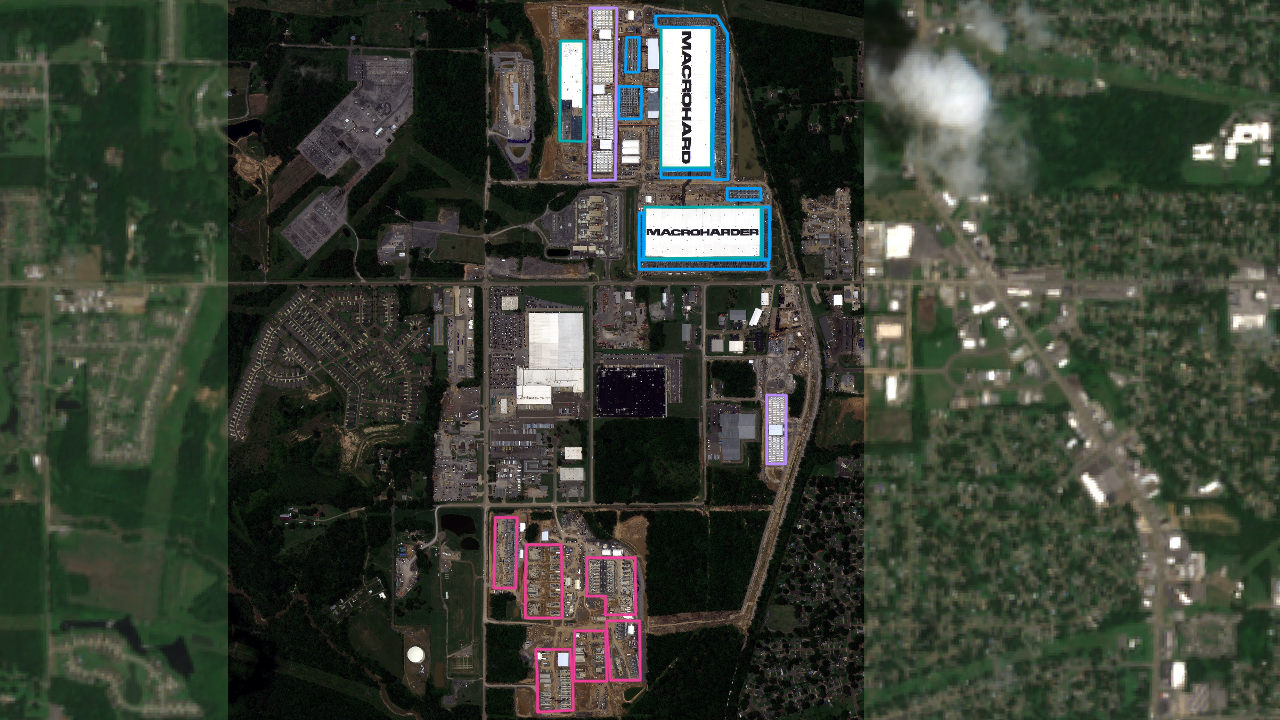
Satellite imagery
CURRENT COMPUTE
1,112k H100-eq
2.20e21 8-bit OP/s
PROJECTED
1,824k H100-eq
3.61e21 8-bit OP/s
CURRENT IT POWER
946 MW
PROJECTED IT POWER
1,531 MW
CURRENT COST
$35.8 B
PROJECTED COST
$58.0 B
Land clearing begins next to the existing building.
Battery facility connected to the building. 121 air-cooled chillers installed, which could support 200 MW. In the Duke faciltiy in nearby Mississippi, several natural gas turbines are in place but not fully connected up.
Battery facility looks complete (though more might be added). Turbines look connected up, minimal construction around them. We believe this state corresponds to the first compute cluster brought online at this site of "approximately 110,000 GB200 processors, approximately 210 megawatts of compute power", as detailed in the company S-1 filing, page 76. Based on those numbers, we believe "compute power" corresponds to GPU server power. Earlier tweets from Elon Musk also support this timing, and it's consistent with the estimated cooling capacity based on the satellite image.
Since October, an array of dry cooling air-cooled condensers has been added (the array of large fans to the left of the building), and appears almost complete. Two more similar arrays appear to be under construction. More air-cooled chillers, batteries, and gas turbines have also been installed.
The first array of dry cooling air-cooled condensers for Building 1 has been completed and is operational. A second array, with larger fans, is about halfway complete (located to the south of the first array). More chillers have also been added. For Building 2, an array of dry cooling air-cooled condensers of the same type as Building 1's first array is beginning construction. We believe this corresponds to the "second cluster of 110,000 GB300 processors and 220 megawatts of compute power" from the company S-1 filing, page 76, with compute power corresponding to GPU server power. This is also consistent with our estimates based on cooling equipment.
The site is estimated to have at least ~830 MW of GPU server power, with at least "at least 220,000 additional GB300 processors and over 400 additional megawatts of compute power", corresponding to the "next phase of expansion" found in the following company S-1 filing, page 76.This estimate is backed up by our cooling and turbine based power production calculations. The cooling calculations suggest there is enough infrastructure to support ~850MW of IT Power. Similarly the energy production calculations support ~900MW of available IT Power. This gives us confidence that the proposed expansion was achieved in time. The roof for building 3 is halfway complete.
Building 3 is estimated to be completed. The site is predicted to have enough power infrastructure installed for a total of 1.5 GW of IT Power. Based on building plans we predict the addition of three more cooling arrays similar to the 6x24 dry coolers near Building 1 and 2. With the completion of current cooling structures and the addition of these arrays there will be ~540MW more cooling capacity for a full facility total of ~1390MW. If this cooling capacity is supplemented by mobile coolers, there would be enough cooling and power infrastructure to support 1.5 GW of IT power.
Read more about our methodology.