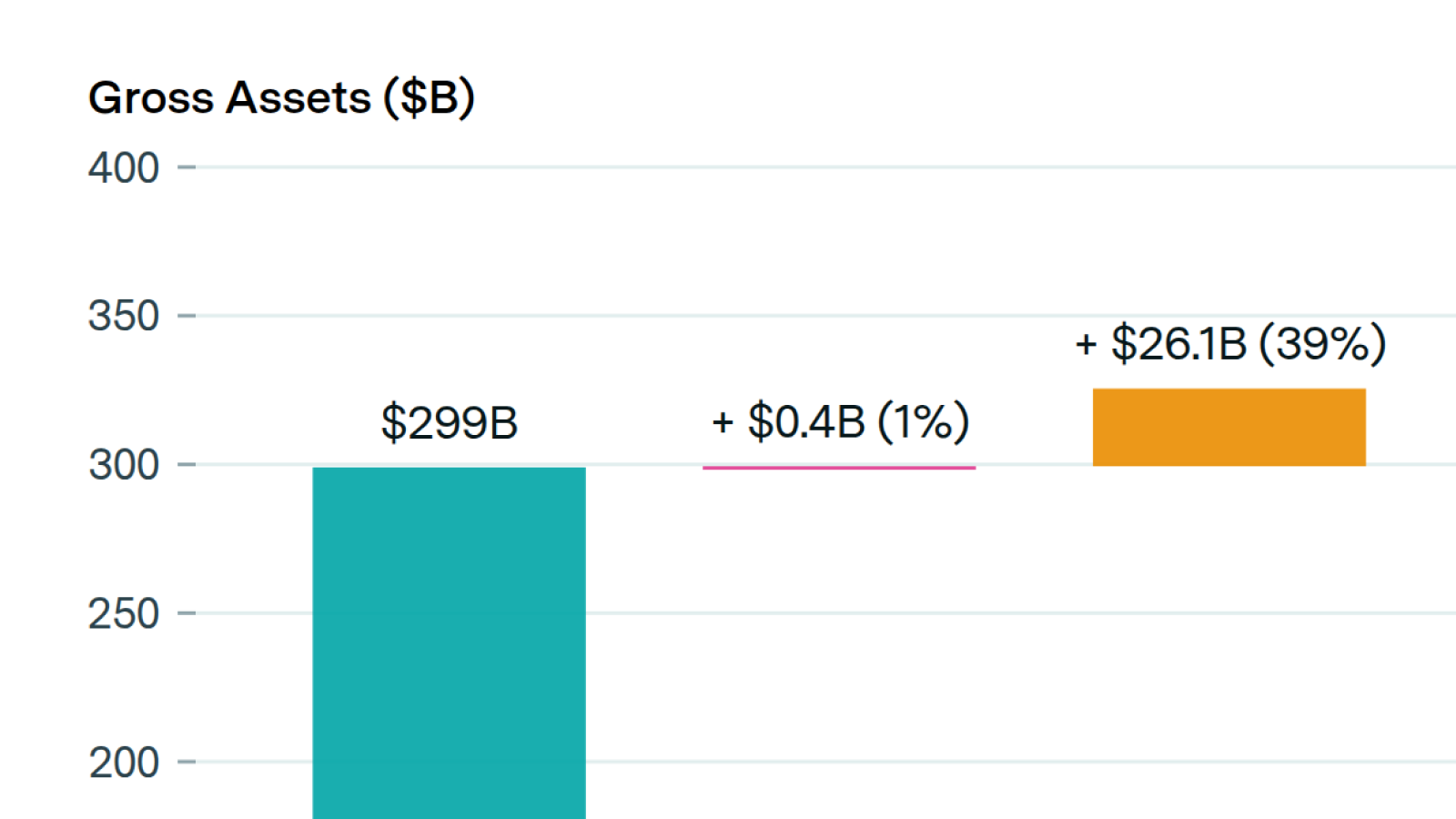

A typical one-gigawatt AI data center requires $38 billion in up-front capital expenditure (CapEx) and $0.9 billion in annual operating expenses (OpEx). If CapEx is annualized over each asset’s lifespan, the total cost of ownership equates to $8.5 billion per year. Servers dominate this cost at $5 billion per year, or 60% of the total. Operating costs are small by comparison: even energy, the largest OpEx category, costs only $0.6 billion per year.
| Cost component | CapEx | OpEx |
|---|---|---|
| Servers | 5,021 | |
| Facility | 1,387 | |
| Network infrastructure | 1,167 | |
| Energy | 594 | |
| Taxes | 143 | |
| Maintenance | 120 | |
| Labor | 40 | |
| Utility works | 20 | |
| Land | 13 | |
| Water | 6 | |
| Total | 7,607 | 907 |
| Cost component | CapEx |
|---|---|
| Servers | 21,188 |
| Facility | 11,433 |
| Network infrastructure | 4,925 |
| Land | 172 |
| Utility works | 164 |
| Total | 37,883 |
The annualization is sensitive to the IT equipment lifespan. We assume 5 years for IT equipment and 14 years for the facility. Shortening the IT lifespan to 3 years raises the total annual cost to $12B; extending it to 7 years lowers the cost to $7B.
Epoch's work is free to use, distribute, and reproduce provided the source and authors are credited under the Creative Commons BY license.
Learn more about this graph
We model the annual cost of a typical AI data center that is owned and operated by a US hyperscaler and has 1 GW of nameplate capacity for the IT equipment. This is a stylized model, not an estimate for any specific facility; actual costs will vary with server choice, facility design, location, financing, and power strategy.
The model builds on Amelia Michael’s earlier data center cost model. The main changes are scaling the facility from 100 MW to 1 GW of IT power (which is not totally linear), assuming all servers are NVIDIA GB200 NVL72 systems rather than DGX H100 systems, and updating selected cost inputs where newer estimates were available. The updated annual total cost of ownership is $8.5 million/MW, down from $10.8 million/MW.
The model is available as a spreadsheet here, including links to sources.
Data
Operating costs
- Energy: Energy costs are a function of electricity prices and energy usage. Energy usage is in turn a function of IT power capacity, power usage effectiveness (PUE), and utilization rate. To estimate electricity costs, we weight EIA state-level industrial electrical costs in 2024 by data center project counts from Aterio, which gives 8.34 cents/kWh. IT power capacity is fixed at 1 GW. PUE is 1.14 based on estimates from Lawrence Berkeley Lab of AI-specialized data center energy usage (Figure 4.5). The utilization rate is 71% based on the average of four estimates collected by Tyler Norris.
- Maintenance: Annual maintenance costs are based on a lifecycle estimate from A.CRE. We sense-check this estimate using public company filings that report repair and maintenance, facility management, and other facility operating costs [example, p.75].
- Labor: Labor costs are a function of the number of employees and wages. The number of employees is based on an estimate from a BCG analysis, which is consistent with empirical values we found. Wages are based on Glassdoor figures.
- Land: Land costs are a function of the number of acres and the per-acre cost. We estimate the number of acres by looking at the ratio of acres to MW for 18 large data centers where both acres and MW are reported [example]. We use an estimate from Cushman & Wakefield of the average cost of data center land in October 2024.
- Tax costs include real property, tangible personal property, sales, and employer payroll taxes. Property tax assumptions use Lincoln Institute and Tax Foundation estimates, with tangible personal property and state unemployment taxes weighted by Aterio state project counts. Sales taxes are assumed to be 0 because most states exempt data center equipment, and property tax abatements are estimated from reported tax status for large data centers.
- Water: Water costs are a function of water usage and water prices. Water usage is based on the Lawrence Berkeley Lab’s average water usage effectiveness estimate for AI-specialized data centers, and water prices use the EPA’s US average commercial water cost.
Capital costs
- Servers and network infrastructure: Server and network infrastructure costs are a function of the number of servers and the cost per server. The number of servers is implied by IT power and the power density of a NVIDIA GB200 NVL72. Server and network infrastructure costs are based on public SemiAnalysis estimates. We approximate the non-server cluster capex as being all for networking.
- Facility: Facility construction costs are based on Turner & Townsend’s data center construction cost index. We use a MW-weighted average across major US markets and include Turner & Townsend’s liquid-cooling cost premium of 7–10%.
- Utility works (substations): Substation costs are a function of power requirements, transformer capacity, and the number of substations required. Assumptions on voltage and substation sizing are based on Dominion Energy; unit costs use MISO’s transmission cost guide.
- Bandwidth (external cabling): Fiber cabling costs are a function of connection distance, cost per kilometer, and equipment costs. Distance is based on a power-plant distribution analysis as a proxy for inter-data center distance. Fiber costs use Cartesian’s US fiber deployment estimate. Equipment costs are based on retailer estimates and specs from Cisco.
Other inputs
- Lifespans: Lifespans are used to annualize capital costs. Facility lifespans are based on data-center lifecycle estimates [example]; server and network lifespans are based on hyperscaler depreciation disclosures and estimates for AI hardware [example].
- Discount rate: The discount rate is the weighted average cost of capital (WACC) for the computer services industry. It is used in the capital recovery factor (CRF) that annualizes capital costs, and to estimate the opportunity cost of land use.
Analysis
To compare capital costs to operating costs, capital costs are annualized. Most capital expenses are converted into annual expenses by multiplying capital expenses by a capital recovery factor (CRF). The CRF depends on the lifetime of the capital and the discount rate. We assume different lifetimes for servers and facilities. Land is treated separately: because land does not depreciate like servers or buildings, we annualize it using the opportunity cost of the capital tied up in the land. The discount rate is the weighted average cost of capital (WACC). We estimate a server/networking CRF of 0.24 and a facilities CRF of 0.13. See Appendix G of Amelia Michael’s report for further detail on the derivation of the CRF.
Assumptions and limitations
This model makes several simplifying assumptions to estimate the cost of a hypothetical facility. All of these assumptions are specified in the spreadsheet; the most significant ones are listed below.
- Typical facility: The model represents a typical 1 GW US hyperscaler AI data center. It does not correspond to an actual data center, and costs may differ substantially by location, design, procurement terms, and server configuration.
- Grid power: We assume the facility is fully grid-powered. We do not model behind-the-meter power generation; adding it would likely increase facility costs and could also change energy costs.
- Server configuration: We model the data center as using NVIDIA GB200 NVL72 systems. Other server types would change both server costs and related infrastructure requirements.
- Location: Many inputs use US averages or weighted averages. Actual costs will vary across states and local jurisdictions, especially for electricity, taxes, land, labor, and construction.
- Tax incentives: Tax abatements are estimated from public information on large data centers. Many incentive agreements are incomplete or not directly comparable, so the abatement estimate is uncertain.
- Annualization: Most capital costs are converted into annual costs using assumed lifespans and a WACC-based capital recovery factor (land is treated as an opportunity cost of capital). Different financing assumptions or depreciation schedules would change annualized costs. For example, the annual cost would be about $13B under a 3-year lifespan for IT equipment, and $7B under a 7-year lifespan.